

A Leicestershire farmer who returned to dairy in 2023 has built a system focused on optimising cow comfort and labour efficiency.
Steve Piece of Foston Lodge Farm, Foston, made the decision to return to milk production after ceasing in 2016, following the milk price crash. During the interim, he went into beef and sheep but always knew that dairying was part of his long-term plan — and a route to maximising the value from his predominantly grass-based 134-ha (330-acre) farm.
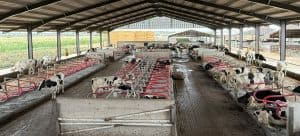
He has since invested in a brand-new cow shed designed around comfort, space, and airflow — something he says has “paid dividends” in terms of improving cow health and milk production.
“Cow comfort was a big consideration,” says Steve. “It’s always been my aim to have a 10,000-litre herd, but I couldn’t achieve that before due to the limitations of the old buildings.
“I had cows capable of yielding 10,000–12,000 litres, but they were being held back — housed in outdated sheds and milked through a parlour that restricted them to just 6,000–7,000 litres.”
Working alongside Andy Dodds of The Farm Consultancy Group, Lely, and Mayo Farm Systems, Steve helped design a shed tailored to the needs of the cows.
Key features include:
-Two Lely milking robots, since upgraded to the latest Lely A5 NEXT models
-128 hybrid flex cubicles, part-funded through the Farming Equipment and Technology
Fund (FETF)
-Perimeter feed trough, to maximise space and reduce feed competition
-Water troughs at every passageway, encouraging intakes and reducing bullying
-15ft-wide alleyways, giving cows ample space and minimising stress
-Open-sided structure with 20ft eaves, enhancing airflow
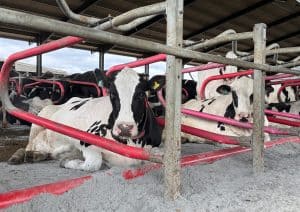
-EnviroBed on Mayo mattresses, promoting comfort, dry udders, and longer lying
times
 Today, Steve is milking 95 cows, with 110 cows in the herd and 80 youngstock. The cows were sourced from multiple farms, with most coming from a herd near Preston previously milked on Lely A3 robots.
When the herd first arrived, yields were averaging 25–27kg/day with somatic cell counts above 200,000. Now, cows are averaging 43kg/day at 3.68% butterfat and 3.38% protein, with cell counts down to 118,000 cells/ml.“It took us about a year to break through the 35kg mark. Now, 19 months in, we’re averaging 43kg, with a peak of 47kg. It’s exceeded where I thought we’d be,” says Steve.
He credits the improvement largely to cow space, promoting lying times through comfortable cubicles and bedding, and a consistent focus on welfare.
“The cubicles are big enough for cows to lie down comfortably, and EnviroBed helps keep them dry. That’s had a noticeable impact. Having plenty of space also helps with bugs, as there’s not the same pressure on the system.
“We previously used sawdust when milking the old herd, but I did a lot of research and watched plenty of YouTube videos before deciding on bedding type for the new herd. Being open-sided, we needed a bedding that wouldn’t blow about, and EnviroBed really stays put.We’ve been really pleased with the outcome.”
EnviroBed is made from 100% recycled paper crumble, dried to 95% dry matter using renewable heat. It has a pH of 7.4, making it gentle on the skin and suitable for use in slurry or AD systems.
Cows are bedded three times a week using a bucket dispenser, with beds scraped daily. Lime is applied on non-bedding days.
“We’re seeing cows lying down more, and we’ve noticed a big drop in foot issues — no bruising or sole ulcers, which we used to get. That’s probably because they’re lying down more.
“We’re also not seeing any hock injuries, thanks to the correct cubicle setup and bedding.”
Steve has also invested in deep-grooving the shed floor to prevent slipping and further support hoof health.
“There’s not one single change that’s made the difference,” he says. “But all the small things we’ve done over the past two years have come together to drive milk production and improve cow health. The Lely NEXT robots have also helped push yields too due to the faster connection time and throughput.”
Cows are being milked through the robots on average 3.2 times a day, with NEDAP collars helping track signs of heat. Steve has also put a greater focus on breeding cows for health traits as well as production, naming his Holstein herd Wyn Lloyd after his late father, who sadly died before the new set-up was complete.
 Steve says the system is designed to offer flexibility and was created to be managed by one person. They currently don’t employ anyone else, with Steve working alongside his mum Hilary, wife Emily, and son and daughter Huw and Lottie.
Farm facts:
-Farming 134 ha (330 acres); 101 ha (250 acres) of which are owned, the rest rented
-112 Holstein Friesians, with 86 followers
-Fed a ration of grass and maize silage, brewer’s grains and a blend. Fed to yield in
the robots
-Supplying Meadow Foods
-Somatic cell count: 118,000 cells/ml, Bactoscan: 12
-Yielding 43kg daily at 3.68% butterfat and 3.38% protein
-LED lighting in shed
-Lely Discovery helps keep passageways clean
-270 Texel cross Mule ewes
-Selling 100 Angus cross dairy store cattle


